

Aggressive fat loss phases offer the upside of losing fat quickly, but are often believed to cause weight regain, predispose disordered eating, or have other side effects. Let’s have a look what science has to say about aggressive diets, evaluate disadvantages and advantages, and think critically about who should or shouldn’t embark on an aggressive dieting journey.
Before I’ll explain you everything about aggressive diets/dieting (AD), let’s go over some clarifications and caveats.
What are aggressive diets?
Well, there isn’t really a definition for AD. What is “aggressive” for somebody, might be tame for others. This is just how you perceive the diet on an individual basis.
What’s easier to standardise, is the magnitude of the deficit, although there still isn’t a definition what is to be considered “aggressive” and what is not. There simply isn’t a clear cut-off.
Often a normal diet ends up being around a 500kcal deficit per day, amounting to about 0,5kg of fat loss per week if everything goes right. If you tell your tracking app that you want to lose weight, most apps will put you at this deficit.
ADs often aim much higher, going for 1000kcal of deficit or even more (done in human research). This way you usually see 1kg of fat loss or more per week. As you can see, this is much faster and needs you to eat way less energy per day. Obviously, this makes ADs much more challenging than a slower approach and therefore not a good fit for everybody.
Who shouldn’t use Aggressive Diets?
ADs get a bad rap, being considered extreme by nature and provoking the classic yo-yo dieting pattern for restricting really hard and then going all out again on the buffet right after the diet is done.
Surprisingly ADs are regularly used in research (and are therefore considered “safe” by ethic commitees) and also in clinical settings. Even their long-time follow up results aren’t worse than “traditional dieting approaches”. Sure, people regain weight after the diet, but this is pretty much always the case, regardless of speed of weight loss.
So, ADs seem to be safe and sound. Are there reasons NOT to diet aggressively? Sure, quite a lot:
- Lacking nutrition knowledge/dieting experience: ADs are really hard to adhere when you don’t know a lot about nutrition. You pretty much are required to track or have all the macros memorised. So if this isn’t your job, like it is the case for me, you need to do your research for every single food item you buy/eat. Calories are on a tight budget, protein needs have to be met.
- Bad relationship to food: due to the aggressive nature of ADs, existing eating disorders/disordered eating patterns will be exposed and potentially triggered. Cravings are bound to flare up. You will experience hunger at certain points and need to be able to cope with it. If you have “trigger foods”, don’t go on an AD, because it will probably make it worse.
- High physical performance goals: if you compete in any sport, or have a physically taxing occupation/hobby, you are going to feel the deficit at some points, especially if you are already relatively lean. Low energy availability is a thing go be considered. This doesn’t mean that you’ll have troubles doing your workouts or doing some cardio, these things aren’t very carbohydate dependant, but more intense exercise might take a hit.
- An overall bad response to higher energy deficits: people are different, so there are just people who react really badly to higher deficits. These individuals might struggle with hunger cues, fatigue, menstrual cycle disruptions, etc. when dieting hard. If this is the case for you, don’t do it and take a slower approach.
A good coach/nutritionist will help you handle these challenges if you still want to do an AD phase, but probably you should first work on these issues.
Advantages of aggressive diets
One of the main advantages of ADs is the fast fat loss you can achieve. This is for many people very motivating and can improve markers for health like blood pressure very fast.
Interestingly, weight regain after a diet seems to be relatively unrelated to how quickly weight was lost in the first place. So no matter how much weight you lose in, e.g. a 6 month diet phase, regain is similar.
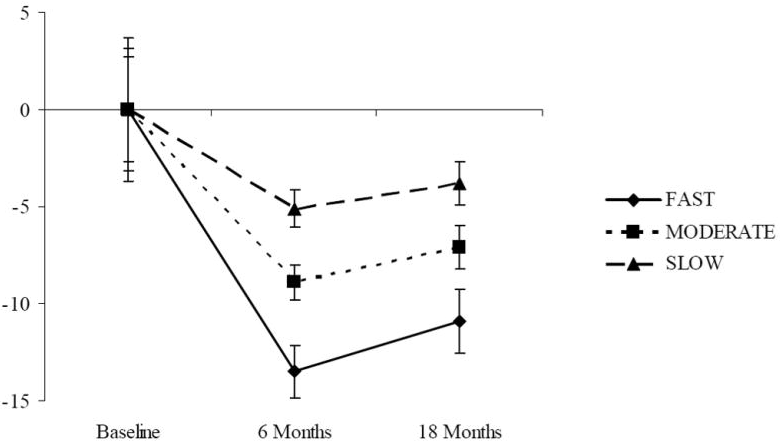
Another potential advantage could be reduced hunger signals when eating very low calories, although the threshold for this to occur isn’t clearly defined and probably very individual. In the literature this seems to occur at somewhere below 1000kcal per day (Wadden et al., Int J Obes. 1987). I’m not sure if I would encourage clients to diet that aggressively, but it is done in research with good success, so it can be considered.
As ADs lead to quicker weight loss, you also reach your fat loss goal faster, meaning you have more time of the year left to not dieting! I think that we all agree that not dieting is the prefered way of living, so spending more time in this cosy state is a big plus.
Disadvantages of Aggressive Diets
Before you jump onto this cool, new thing, I want you to know that there are also some disadvantages that you should keep in mind before you go in. As mentioned before, this isn’t for everybody and this isn’t the only or the best approach to dieting! So, what are the cons? Glad you’ve asked:
- Eating less food: overall there will be little food. Depending on how low you want to go, this may be challenging for some.
- More restrictive: you want to keep calorie intake very low, so food choices are limited. Think berries instead of bananas or courgette instead of potatoes.
- Decreased athletic performance: for athletes the large deficit may be reducing their ability to perform. Few of us are true athletes though 😉 …
- Reduced recovery: being in a large deficit for longer periods may reduce your overall ability to recover from stress, be it training stress or overall “life-stress”. Take this into account and be mindful and compassionate towards yourself.
- Greater degree of metabolic adaptations: ADs may increase metabolic adaptions earlier than normal diets (e.g. feeling cold or tired). AD phases should be short though, so this might not even be noticeable in practice.
- May pre-dispose to overshoot food intake after the diet: restrictive diets may trigger certain personalities to overeat after the diet is over. Make sure to have a plan/coach to structure your post-dieting phase and not jump right back to old habits.
How to diet aggressively?
Setting an AD up isn’t very difficult. You calculate your maintenance calories and choose a deficit to challenge you (e.g. 1000kcal per day). Subtract from your maintenance calories and you have your dieting calories.
Set your protein to about 1,5-1,8g/kg bodyweight and fill out the remaining macros as you like. I’ve written an article on this if you need help doing so. Usually, I wouldn’t try to hit certain carb or fat goals and just “flow” with what happens to be. Both of them will be quite low anyways, there usually isn’t too much upside in even bothering to hit certain numbers or keeping something artificially low or high.
After that, the hard part begins: actually adhering to the deficit. As mentioned in the “red flags of AD” part, you should already be quite good at knowing what types of food you need to consume when dieting. Overall you need:
- Low calorie sources of protein
- High satiety “filler” foods
- Low to zero calorie snacks
- Zero calorie beverages
Yes, that’s probably going to be a lot of lean fish, chicken breast and plenty of vegetables and fruits while drinking mainly water.
the Aggressive Dieting Mindset
I think to have a successful AD experience, a certain mindset is important. For a lack of a better term, a “positive place” should be the starting point. You should see this phase as an exciting challenge for yourself, like climbing a mountain or running a marathon. This is a fun project that you should look forward to embark on.
Every diet should embrace the concept of “unconditional permission to eat”. If you feel hungry or really want to eat that birthday cake, you should allow it, savor it, enjoy it fully. No purging, no “making up for it”, no regrets. This is especially true for ADs! Sure, this is a phase where you deliberately try to eat very few calories, but this doesn’t mean you can’t make room for deviations. A cookie won’t ruin your progress!
I would even argue that ADs make it easier to fit in “pleasure foods” on occasion just because you are in such a large deficit. Eating a cake for 500kcals still puts you into a 500kcal deficit if your daily deficit is 1000kcal. You will still make progress. Relax and enjoy life <3.
Training and Cardio during AD phases
An AD phase is not the right time to push training hard. We’ve already talked about the possibility of decreased performance and/or recovery, so this shouldn’t be a surprise to you. Low energy availability can creep up to you, so keep training at reasonable volumes/intensity. Make sure you are able to recover and have fun while training. Send your body a solid message to keep muscles, don’t try to destroy muscles.
Especially with the highly repetitive movements during cardio training, make sure not to overdo it, as exactly this is the recipe for overuse injuries. Maybe try to incorporate a different movement form to give your body a break between sessions. It might be also a good idea to have different forms of cardio training so you are slightly more “inefficient” when training and burn a few extra calories.
When to stop dieting aggressively?
Quite frankly, you should stop when it’s not “fun” anymore. Signs that you shouldn’t diet that aggressively include loss of menses, bad sleep, fatigue, illness, increasing food focus, insatiable hunger, and so on. When everything feels just hard, except for the things that should be hard, it’s time to transition away.
After an AD phase you are free to continue to chase other goals that maybe came a little too short when dieting. If you decide to maintain your new, much lower weight, keep in mind that you will gain a little weight from switching to a higher calorie diet, even if eating true maintenance calories. You will replenish glycogen stores and often pull a little more water, so don’t freak out when the scale goes up a little.
Remember that dieting should never be a way to live your life, so make sure to spend way more time not dieting than dieting. Take care, I hope it helps <3!
 Beary Strong
Mindfulness ❤
LikeLike